 by
by 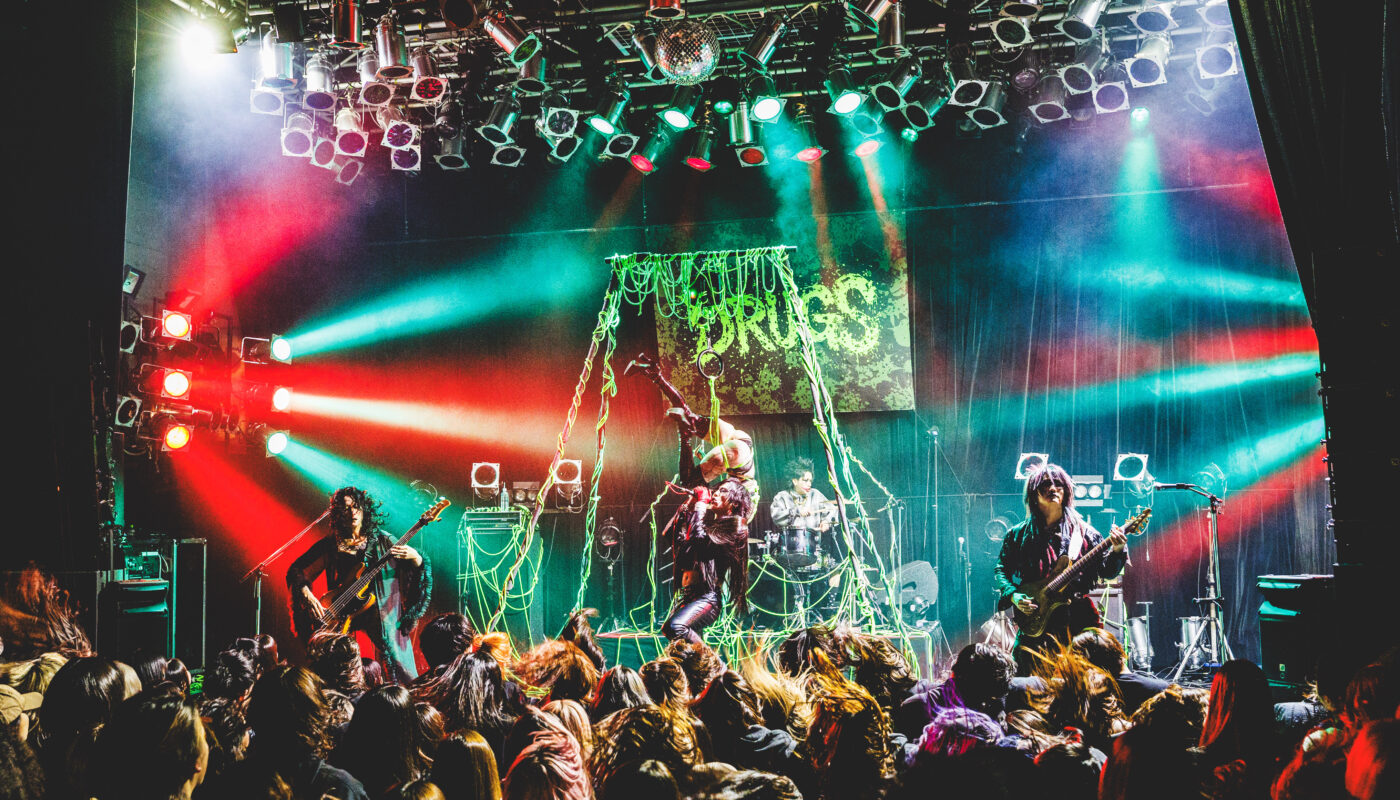
🇫🇷 FRANCAIS | 🇬🇧 ENGLISH | 🇩🇪 DEUTSCH
🇬🇧 ENGLISH
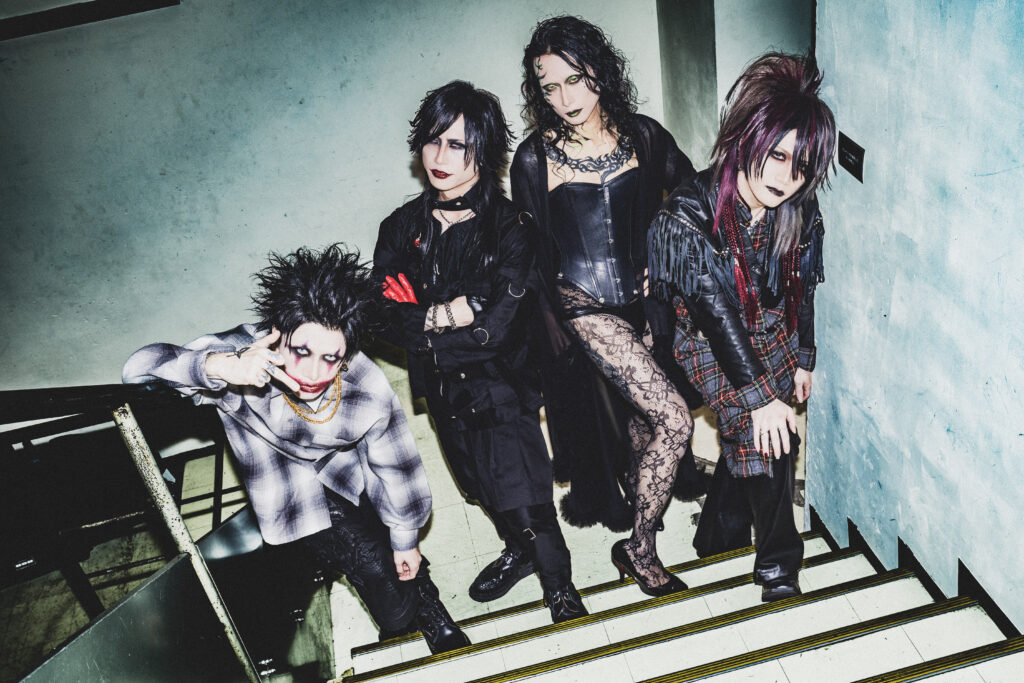
It was under a name as provocative as their aesthetic that DRUGS emerged in June 2025. This unexpected line-up brings together four prominent figures of the visual kei scene: Tsuzuku on vocals, Taizo on guitar, Shindo Wataru on bass, and Yoshiatsu on drums. A name that mirrors their music — psychedelic, raw, unsettling, yet undeniably addictive. Although their activities only truly began in December, the band has been moving at a relentless pace, already boasting seven digital singles and one full-length album, “D/D/D”. On February 17, 2026, DRUGS took over the stage at Spotify O-WEST in Tokyo for their second one-man show, 【THE NORMAL】. Let us dive into the band’s singular world for an experience beyond the ordinary.
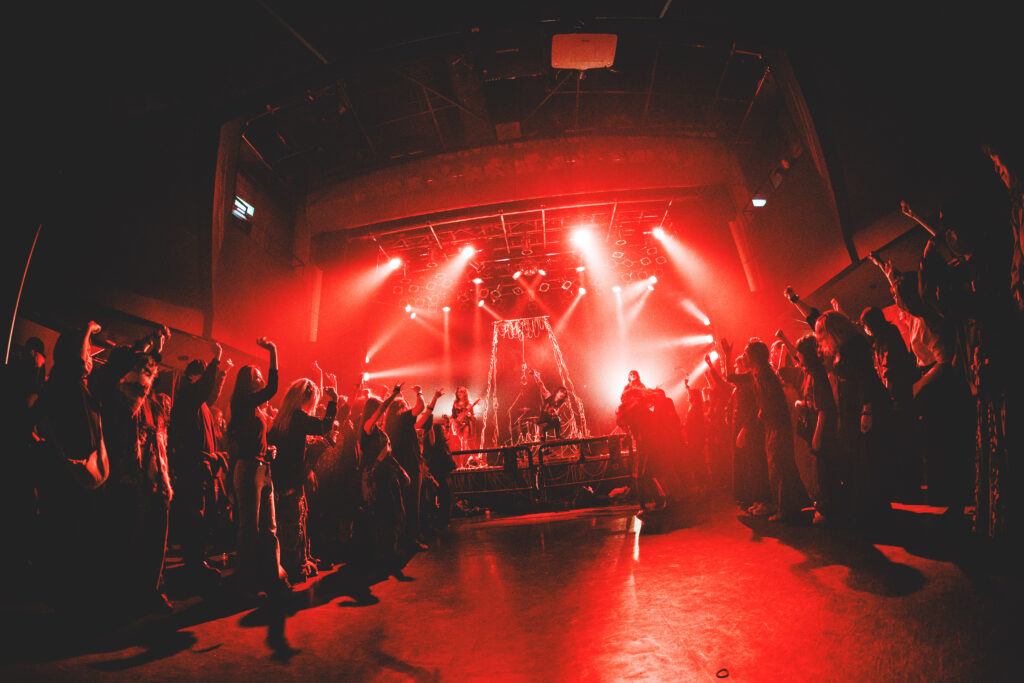
As the introduction echoes through the venue, the curtain rises on a staging that is anything but conventional. At center stage stands a large scaffold-like structure wrapped in fluorescent ropes, with a ring suspended in its middle. The same glowing cords are scattered across the entire stage — on the floor, over the amplifiers, even around the drums — in what appears to be chaos, yet clearly the result of meticulous design. A green light bathes the set, recalling the hue of the band’s logo and heightening the unsettling atmosphere. It is within this striking setting that the three musicians step forward to greet the audience, soon joined by Tsuzuku. The vocalist advances slowly, arms crossed over his chest, his gaze icy and detached, further amplifying the almost disturbing tension emanating from the stage, as the crowd erupts in fervent cheers.
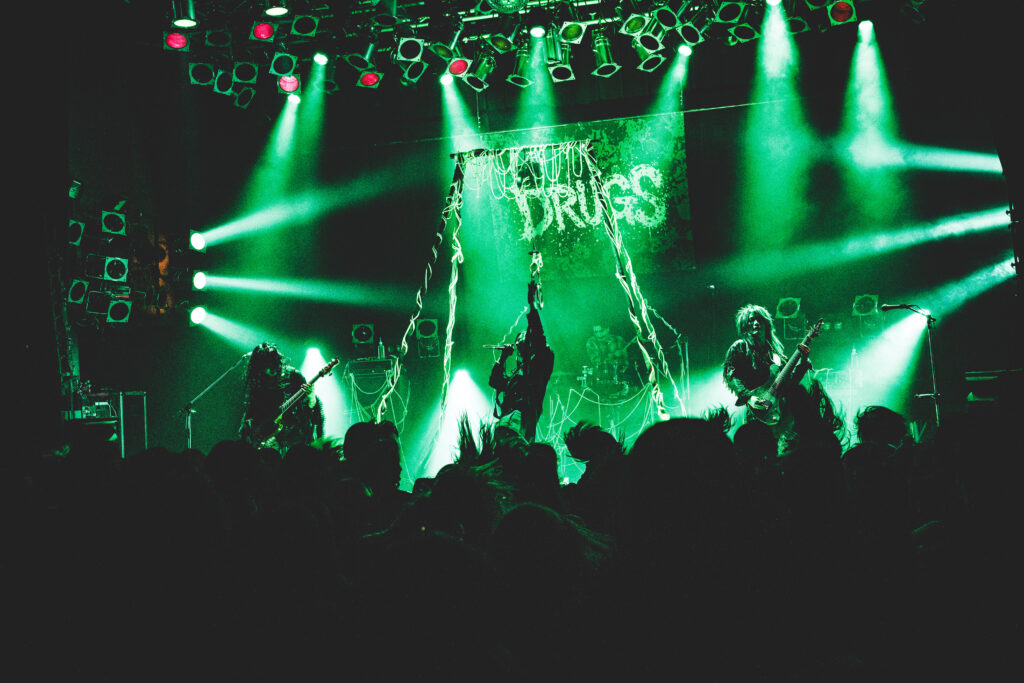
The opening notes of “Kansen no usage” (感染の宴), an unreleased track, ring out as Tsuzuku leaps onto his platform, forcefully stamping the floor. The stage ignites in an aggressive red light, perfectly matched to his powerful growls. Within seconds, the tone is set: Tsuzuku, Taizo, and Shindo Wataru headbang in unison, immediately mirrored by a crowd ready to dive headfirst into their universe. The chorus brings a brief moment of relative calm, bathed in white light under which hands rise into the air. Yet the tension surges back almost instantly as the growls return with renewed intensity. Tireless, Taizo strings together headbangs and steps forward to engage with the audience, drawing even the last hesitant spectators into the band’s spiraling sonic vortex.
From the very first notes of “CARVED IN ALMA”, the crowd seems fully awakened — or perhaps already pulled into that state of semi-consciousness that DRUGS methodically cultivates. Raised fists, jumps, and screams answer the musicians’ frenzied headbanging. During the chorus, Yoshiatsu pounds his drums with striking power, effortlessly commanding a breakneck tempo. Tsuzuku’s screams cut through with force, Taizo’s riffs slice through the air, while Shindo Wataru’s wide, sweeping headbang lends a certain elegance at the heart of this surge of raw energy.
After a few words to the audience to ensure that everyone is already caught in the machinery — right to the back of the venue, which he refuses to overlook — Tsuzuku launches into “UNTIL I DIE”. Barely have the first notes rung out than he and Taizo begin headbanging with force, signaling another surge of adrenaline. The crowd responds without restraint: jumps, headbanging, hands clapping in rhythm, and “Hey! Hey!” shouted at the top of their lungs. Tsuzuku thrusts his microphone toward the pit, then crouches on his platform to scream back in return, sweeping his gaze across the venue before demanding, “Louder!” Taizo, tireless, also urges the audience on with a wave of his hand, while Yoshiatsu watches their reaction closely. The track electrifies the entire venue, driving the tension even higher and setting the stage for what is to come.
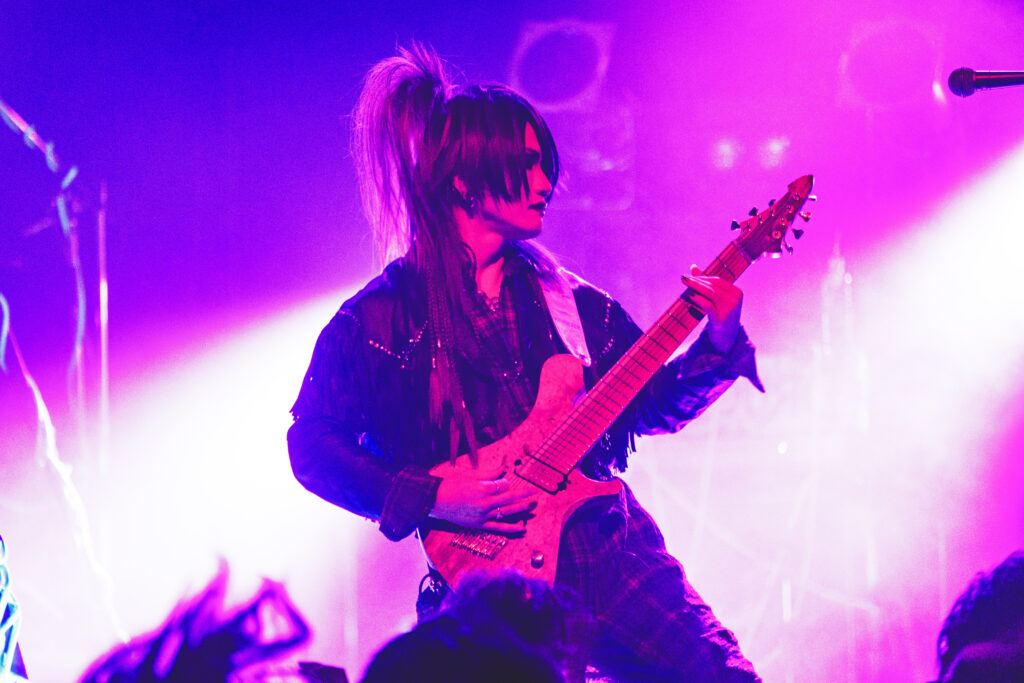
“Shi, seisatsu” (死、省察) acts like a shift in substance, abruptly slowing the pace. Bathed in a golden halo, Taizo lets clear notes ring out, slicing through the silence, accompanied by a slow movement of his head. Then the quiet turns almost oppressive as Tsuzuku steps forward. His breath fills the microphone before a murmur rises, like a lament, a piercing complaint that cuts straight through the heart. Now drenched in the same golden light, supported only by a few chords from Taizo, he suddenly unleashes a shrill, tearing scream, triggering the explosive entrance of the other musicians. The tempo remains slow, each note seemingly dissected and laid bare. Yoshiatsu’s drums crack like muted detonations, while a solo from Taizo briefly softens the tension. The track highlights the full depth of Tsuzuku’s interpretative talent: his voice wavers, pleads, then bursts into raw pain. He bends, twists, as if consumed from within, the only one in motion before musicians and audience alike frozen in place. The moment is poignant, the emotions unfiltered. With one final scream, he collapses to his knees, seemingly undone, leaving the venue suspended in that vertiginous descent.
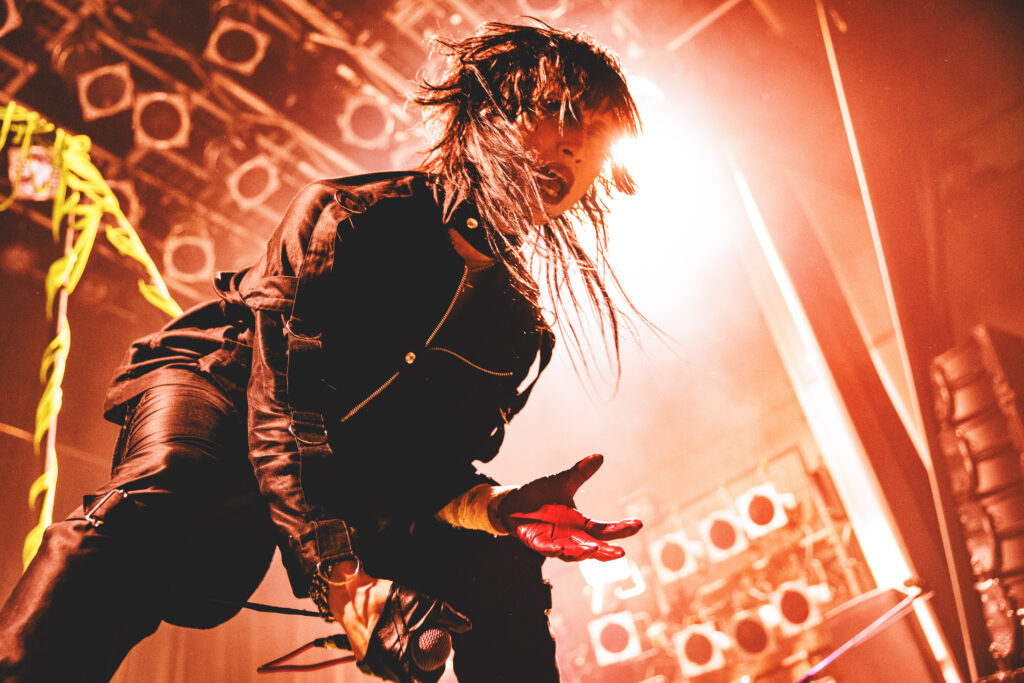
Still on the floor, Tsuzuku’s breath rises into the microphone, soon mingled with muffled sobs, as if curled in on his own distress. The dramatic tension in the room becomes almost suffocating. Suddenly, he strikes the microphone: the impact echoes dully, sending a chill through the atmosphere. In the background, Taizo stretches out high, distorted chords, deliberately abrasive, intensifying the palpable unease. Tsuzuku then drags his microphone against the platform, producing a disturbing screech, before the transition unfolds into “Flesh and Halo”.
Tsuzuku eventually rises and slowly makes his way to the scaffold. Grasping the suspended ring, he lets himself spin, as though stripped of balance, his body surrendered to this strange levitation. The lights soften, shifting between green, blue, and violet, until the eruption of a new growl reignites the fever and sets the pit back into motion with renewed headbanging. Taizo overflows with energy: after a solo bathed in golden light, he returns to his platform, animated by jerky, almost disjointed movements, before spinning, jumping, and stepping forward to lock eyes with the audience at close range. Amid the screams, he raises his arm to rally the room, while Shindo Wataru arches back as he plays. The track ultimately detonates into a collective, frenzied headbang. With one final piercing scream, Tsuzuku hurls his microphone onto the platform and leaves the stage without a backward glance, leaving the atmosphere suspended in his wake.
What follows is an unprecedented sequence on a visual kei stage: a rope performance orchestrated by Shindo Wataru, supported by Yoshiatsu’s precise strikes and Taizo’s dissonant, distortion-saturated notes. A young woman joins the stage, already partially bound with ropes. Shindo Wataru takes hold of one, brushes lightly on her face, and circles her with calculated slowness, almost predatory, before fastening her more securely and threading the rope through the suspended ring on the freestanding rigging frame. The steady “tick” of the drums and the shrill guitar notes establish a raw, unsettling tension. Shindo Wataru moves with grace, taking his time to tighten the knots before lifting the model and slowly rotating her. Unsatisfied, he adds more ropes as the music intensifies, drums and guitar building in power like a surge of adrenaline perfectly synchronized with the performance. Soon suspended upside down, the young woman turns slowly under the captivated gaze of the audience.
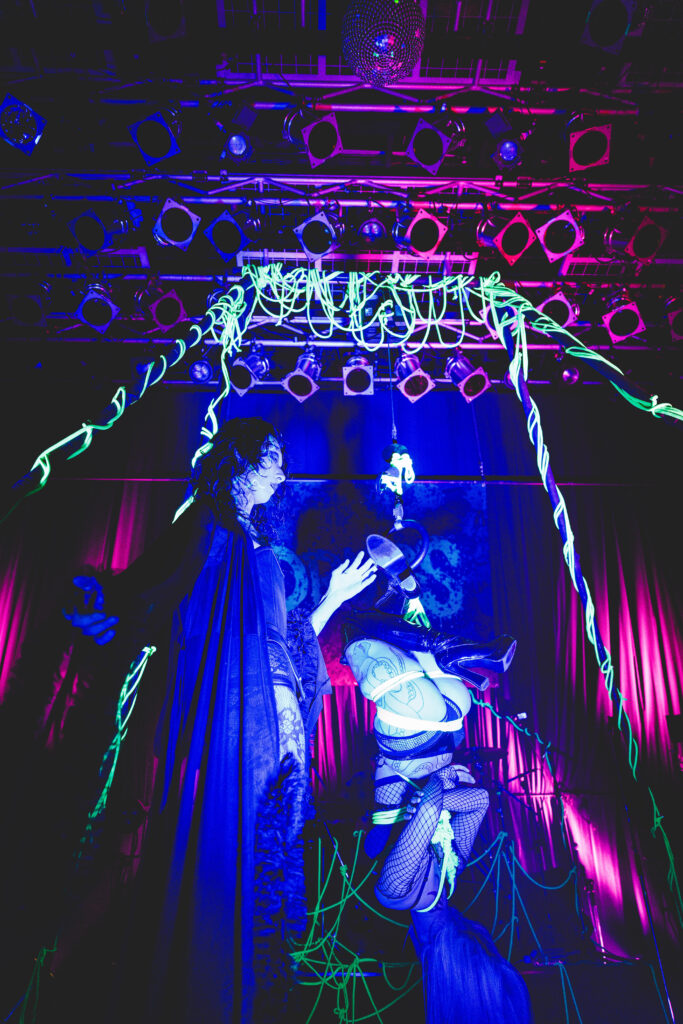
Beneath a red halo, the music fully takes shape once more: Yoshiatsu strikes with force, Taizo launches into a true riff, and Shindo Wataru returns to his bass. The model, until then inert like a doll, comes to life, straightens up, and begins a choreography while still suspended, as Tsuzuku reclaims the stage. Suspended outside of time, this tableau illustrates DRUGS’ artistic ambition, whose expression extends beyond the sonic realm to embrace performance in its most total form.
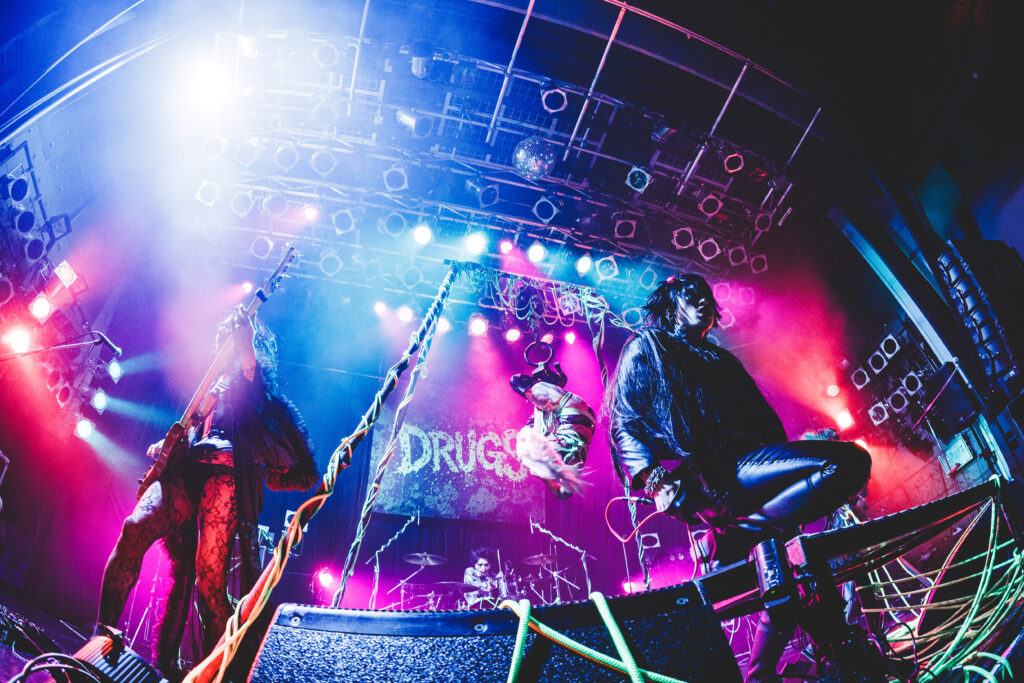
“NEW ORDER” follows seamlessly, extending the unsettling atmosphere established moments earlier. Taizo continues to weave saturated, abrasive textures, while Yoshiatsu strikes his drums with unwavering intensity. Shindo Wataru embodies every vibration, letting the music course visibly through his body. The track offers Tsuzuku a space for total expression: nearly stifled murmurs in the verses, deep growls, pig screams, and precisely delivered high-pitched flights — he unfurls the full range of his vocal palette. As the song draws to a close, the performer frees herself and exits the stage, while Tsuzuku urges the crowd to raise their voices before launching straight into “THE LIBRA”.
Kneeling on his platform, Tsuzuku headbangs violently, soon mirrored by Shindo Wataru and Taizo, while the pit follows without pause. Fans jump with raised hands, clap in rhythm, and chant powerful “Hey! Hey!”, still driven by undiminished energy. The music suddenly falls into suspension, leaving only Yoshiatsu’s light strikes echoing through the venue. Tsuzuku then calls out to the crowd: “Are you still alive?”, before hurling a provocative “Die!”, beneath the drummer’s unsettling smile and Taizo’s distorted notes. Deeply possessed by the music, Taizo alternates between extreme backbends and sharp head movements in time with the track.
The pressure keeps mounting with “Trite and nauseating”. The band chains together relentless headbanging while continuously demanding the crowd’s participation, always pushing for more. Standing atop his platform, Tsuzuku urges the venue on: “Louder! I can’t hear you!”, unleashing yet another wave of screams, even more powerful than before, as an almost instinctive response to his provocation.
If there is one track that truly places Shindo Wataru in the spotlight, it is “Echoes of the Hidden Self”. Though seemingly more measured, with less aggressive riffs from Taizo, the song remains no less intense, as evidenced by the pit, which headbangs without restraint from the very first chorus. The end belongs to the bassist, who delivers a confident solo before urging the crowd to raise the volume even higher. Tsuzuku calls out all the way to the back of the venue to ensure that everyone is fully immersed in the moment, while Yoshiatsu’s smile behind his drums leaves no doubt about the sheer enjoyment he takes in delivering this performance.
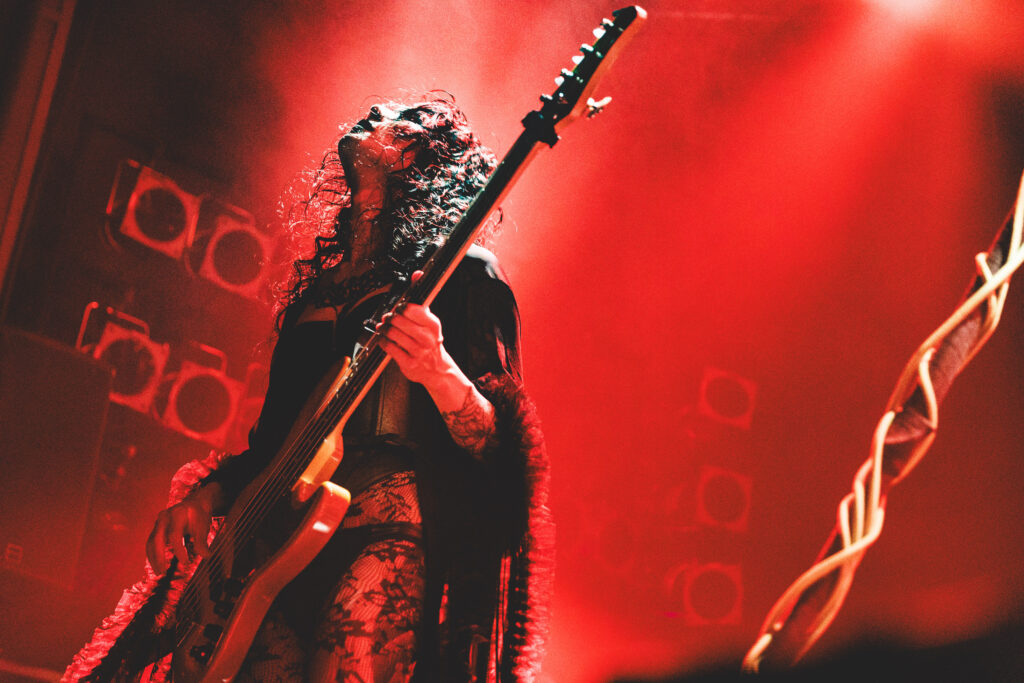
With “E,M,M,M,” DRUGS quite literally sets the venue ablaze. The fans throw themselves into increasingly intense moshes, growing in scale as the band doubles down on its energy. Shindo Wataru launches the backing chants, instantly echoed by a crowd shouting “Hey! Hey!” in perfect unison. Taizo, hand cupped behind his ear, urges the pit to raise the volume even higher — and the screams surge immediately in response. Vocalist, guitarist, and bassist trade places, crisscrossing the stage to multiply interactions, even leaning over the barrier to watch the crowd’s movements up close. Tsuzuku, first positioned on the left, stretches out his arm to brush a few outstretched hands before repeating the gesture on the right, then sits on his platform to observe with satisfaction as bodies sway from side to side. Beneath the freestanding rigging frame, Taizo and Shindo Wataru briefly play around with the suspended ring. Still insatiable, Tsuzuku calls for a circle pit: the audience eagerly complies, running in a circle at the center of the venue. Behind his drums, Yoshiatsu smiles without pause, visibly relishing the collective frenzy unfolding before him.
At the end of the song, Tsuzuku takes a moment to address the audience with heartfelt sincerity. He expresses his gratitude and shares his ambitions: “I have no intention of stopping at WEST. One day, I want to return to EAST, one day I want to go to Zepp, and I want us to go together to places you have never seen before. This isn’t my selfishness speaking. It’s a dream I will fulfill before I die.” After a rallying message encouraging the crowd to keep following them, Tsuzuku reaffirms his determination to move forward and to live fully — both as a man and through the music of DRUGS: “Please… will you follow me until my death? This is my declaration: I will continue to live. Can you hear me? Can you see me? Can you see DRUGS? Can you hear the sound of DRUGS? All of this reaches you, doesn’t it? Let’s go together to the other side of this dream that will never fade.”
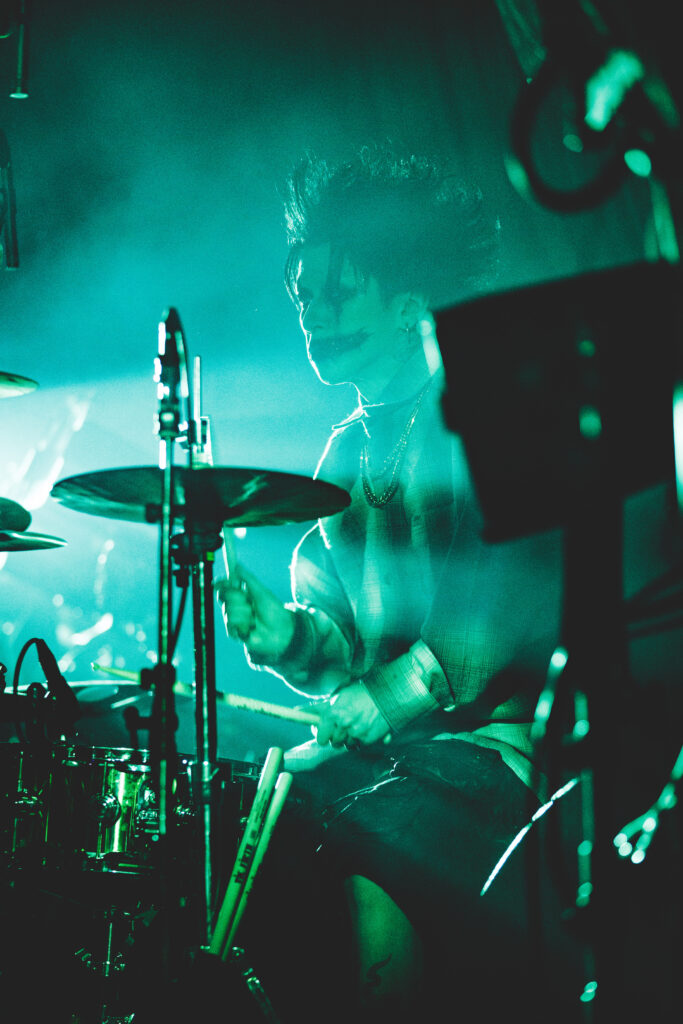
“Baku” (貘) closes out the main set, once again highlighting the synergy between guitar and bass. Yoshiatsu, tireless, strikes his drums with unbroken power despite the show’s progression, his wide smile betraying the joy he takes in living the moment to the fullest. Tsuzuku caps the song with a long, piercing scream, before the musicians leave the stage to the audience’s applause.
But the crowd refuses to let the night end there. Voices unite, demanding an encore, which is immediately granted. Squatting on his platform, Tsuzuku provocatively repeats, “Die! All of you, die!” before launching into the final track of the evening: “BABY”.
The tone is set instantly: Tsuzuku splits the venue in two for a wall of death of formidable intensity. He urges the fans to lock eyes, each side poised for impact, before his growls trigger the collective collision. The clash is brutal yet controlled. Taizo takes advantage of the chaos to play with the suspended ring, hanging from it and swinging with his feet raised, drawing amused laughter from Yoshiatsu behind his drums. Wall of deaths follow one after another, the temperature rises further, and the atmosphere turns completely wild. Between headbangs, screams, and growls, the boundary between stage and pit dissolves: DRUGS and audience become one. Ever in command of the tension, Tsuzuku questions the crowd about their stamina before hurling “Die!” to the right and left — words that, in his mouth, take on the tone of a fervent declaration. Carried by this intensity, the audience responds in kind, determined to give everything without restraint. Taizo and Shindo Wataru stride from one end of the stage to the other, punctuating the song by shouting into their microphones and multiplying interactions, while Tsuzuku extends his mic toward the pit, inviting fans to scream into it in turn and deepening this powerful communion even further.
One final wall of death, one last barrage of headbangs, and the inevitable becomes clear: the night is drawing to a close. After exchanging a few final glances with the crowd, Tsuzuku leaves the stage, closely followed by Taizo and Shindo Wataru. Yoshiatsu, true to himself, calls for one last wave of cheers before grabbing the ring and swinging from it with a laugh, offering a final salute to the audience beneath their warm applause.
DRUGS lives up to its name with striking accuracy. From the very first notes, the band pulls us into a singular, psychedelic universe where all restraint dissolves. With them, there are no more barriers, no limits — only raw sound and the expression of a total art form to which one surrenders with almost wild intensity. It is an immersive, visceral experience, one that leaves you electrified. And if there is any risk in diving into DRUGS’ world, it is certainly not overdose — but addiction. The band makes no mistake in having named its fans the “dopes”, a name that perfectly reflects the fusion-like bond uniting them with their audience.
For those willing to give in to the temptation, DRUGS has already announced its next one-man show, titled 「THE DOPES」. It will take place on August 8, 2026, at Shibuya WOMB in Tokyo, another opportunity to plunge, without restraint, into their extraordinary universe.
photos: Matsumoto Yuu
SETLIST
2026.02.17 – DRUGS 2nd one-man【THE NORMAL】, Spotify O-WEST, Tokyo, JAPAN
Se
01. 感染の宴 (Kansen no usage)
02. CARVED IN ALMA
03. UNTIL I DIE
04. 死、省察 (Shi, seisatsu)
05. Flesh and Halo
Rope performance
06. NEW ORDER
07. THE LIBRA
08. Trite and nauseating
09. Echoes of the Hidden Self
10. E,M,M,M
11. 貘 (Baku)
Encore
12. BABY
Links
DRUGS 


Tsuzuku
Taizo
Shindo Wataru
Yoshiatsu
🇬🇧 FRANCAIS
C’est sous un nom aussi provocant que leur univers que DRUGS voit le jour en juin 2025. Cette line-up inattendue réunit quatre figures marquantes de la scène visual kei : Tsuzuku au chant, Taizo à la guitare, Shindo Wataru à la basse et Yoshiatsu à la batterie. Un nom à l’image de leur musique — psychédélique, brute, dérangeante et pourtant résolument addictive. Bien que leurs activités n’aient réellement débuté qu’en décembre, le groupe avance à un rythme effréné : déjà sept singles digitaux et un album, “D/D/D”, à leur actif. Le 17 février 2026, DRUGS investissait la scène du Spotify O-WEST à Tokyo pour son deuxième one-man, 【THE NORMAL】. Plongeons dans l’univers singulier du groupe pour une expérience hors norme.
Alors que l’introduction résonne, le rideau se lève sur une scénographie pour le moins atypique. Au centre trône un large portique évoquant un échafaud, enlacé de cordes fluorescentes, avec un anneau suspendu en son milieu. Ces mêmes cordes sont disséminées sur toute la scène — au sol, sur les amplis, jusqu’à la batterie — dans un apparent désordre soigneusement étudié. Une lumière verte enveloppe l’ensemble, rappelant la teinte du logo du groupe et renforçant l’atmosphère troublante. C’est dans ce décor saisissant que les trois musiciens viennent saluer le public, bientôt rejoints par Tsuzuku. Le chanteur avance lentement, bras croisés sur la poitrine, le regard froid, accentuant encore la tension presque inquiétante qui se dégage de la scène, sous les acclamations nourries de la salle.
Les premières notes de Kansen no usage (感染の宴), un titre inédit, retentissent tandis que Tsuzuku bondit sur sa plateforme, martelant le sol avec force. La scène s’embrase d’une lumière rouge agressive, parfaitement accordée à ses growls puissants. En quelques secondes, l’ambiance est donnée : Tsuzuku, Taizo et Wataru headbanguent à l’unisson, immédiatement suivis par un public prêt à plonger dans leur univers. Le refrain apporte une accalmie relative, baignée d’une lumière blanche sous laquelle les mains se lèvent. Mais la tension remonte aussitôt : les growls reprennent de plus belle. Taizo, infatigable, multiplie les headbangs et s’avance pour interagir avec la foule, entraînant les derniers hésitants dans la spirale sonore du groupe.
Dès CARVED IN ALMA, la foule semble pleinement réveillée — ou au contraire déjà happée dans cet état de semi-conscience que DRUGS distille avec méthode. Poings levés, sauts et cris répondent aux headbangs frénétiques des musiciens. Sur le refrain, Yoshiatsu martèle sa batterie avec une puissance impressionnante, maîtrisant sans effort un tempo effréné. Les cris de Tsuzuku sont puissants, les riffs de Taizo fendent l’air, tandis que le headbang ample de Wataru insuffle une forme d’élégance au cœur de cette décharge d’énergie brute.
Après quelques mots adressés au public pour s’assurer que chacun est déjà pris dans l’engrenage — jusqu’au fond de la salle qu’il refuse d’oublier — Tsuzuku lance UNTIL I DIE. À peine les premières notes retentissent que lui et Taizo headbanguent avec vigueur, donnant le signal d’une nouvelle montée d’adrénaline. La foule répond sans retenue : sauts, headbangs, mains qui frappent en rythme et « Hey ! Hey ! » scandés à pleins poumons. Tsuzuku tend son micro vers la fosse, puis s’accroupit sur sa plateforme pour hurler en retour, balayant la salle du regard avant d’exiger un « Plus fort ! ». Taizo, infatigable, encourage lui aussi les cris d’un geste de la main, tandis que Yoshiatsu observe attentivement la réaction du public. Le morceau électrise la salle tout entière, intensifiant encore la tension et préparant le terrain pour la suite.
Shi, seisatsu (死、省察) agit comme un changement de substance, ralentissant brutalement le rythme. Dans un halo doré, Taizo laisse résonner des notes claires qui fendent le silence, qu’il accompagne d’un lent mouvement de tête. Puis le silence devient presque oppressant lorsque Tsuzuku s’avance. Son souffle envahit le micro avant qu’un murmure ne s’élève, comme une lamentation, une plainte poignante qui transperce le coeur. Baigné à son tour de lumière dorée, simplement soutenu par quelques accords de Taizo, il pousse soudain un cri aigu déchirant, déclenchant l’entrée explosive des autres musiciens. Le tempo reste lent, chaque note semblant disséquée, exposée. La batterie de Yoshiatsu claque comme des détonations sourdes, tandis qu’un solo de Taizo vient brièvement adoucir la tension. Le morceau met en lumière tout le talent d’interprétation de Tsuzuku : sa voix vacille, implore, puis éclate dans une douleur brute. Il se courbe, se tord, comme consumé de l’intérieur, seul en mouvement face à des musiciens et un public figés. Le moment est poignant, les émotions brutes. Dans un ultime cri, il s’effondre à genoux, comme anéanti, laissant la salle suspendue à cette descente vertigineuse.
Toujours au sol, le souffle de Tsuzuku s’élève dans son micro, bientôt mêlé à des sanglots étouffés, comme recroquevillé dans sa propre détresse. La tension dramatique devient presque suffocante dans la salle. Soudain, il frappe le micro : le choc résonne sourdement, glaçant l’atmosphère. En arrière-plan, Taizo étire des accords aigus, distordus, volontairement abrasifs, accentuant ce malaise palpable. Tsuzuku frotte alors son micro contre la plateforme dans un grincement troublant, avant que la transition ne s’opère vers Flesh and Halo.
Tsuzuku finit par se relever et rejoint lentement le portique. Il saisit l’anneau suspendu et se laisse tourner, comme privé d’équilibre, corps abandonné à cette étrange lévitation. Les lumières se font plus douces, oscillant entre vert, bleu et violet, jusqu’à l’irruption d’un nouveau growl qui ravive la fièvre et relance les headbangs dans la fosse. Taizo déborde d’énergie : après un solo baigné dans une lueur dorée, il regagne sa plateforme, agité de mouvements saccadés presque désarticulés, avant de tourner, sauter et venir capter les regards au plus près du public. Sous les cris, il lève le bras pour entraîner la salle, tandis que Wataru se cambre pour jouer. Le morceau explose finalement dans un headbang collectif et frénétique. Dans un ultime cri aigu, Tsuzuku jette son micro sur la plateforme et quitte la scène sans un regard en arrière, laissant l’atmosphère suspendue.
Place alors à une séquence inédite sur une scène visual kei : une démonstration de bondage orchestrée par Wataru, soutenue par les frappes précises de Yoshiatsu et les notes dissonantes de Taizo, saturées de distorsion. Une jeune femme rejoint la scène, déjà partiellement entravée de cordes. Wataru en saisit une, effleure son visage, tourne autour d’elle avec une lenteur calculée, presque prédatrice, avant de l’attacher et de faire passer la corde dans l’anneau suspendu au portique. Les “tic” réguliers de la batterie et les notes stridentes de la guitare installent une tension brute et dérangeante. Wataru évolue avec grâce, prenant le temps de resserrer les liens avant de soulever le modèle et de la faire lentement pivoter. Insatisfait, il ajoute de nouvelles cordes, tandis que la musique gagne en intensité, batterie et guitare montant en puissance comme une montée d’adrénaline parfaitement synchronisée avec la performance. Bientôt suspendue la tête en bas, la jeune femme tourne lentement sous le regard captivé du public.
Sous un halo rouge, la musique reprend pleinement forme : Yoshiatsu frappe avec force, Taizo lance un véritable riff, et Wataru retourne à sa basse. La modèle, jusque-là inerte comme une poupée, s’anime, se redresse et amorce une chorégraphie tout en restant suspendue, alors que Tsuzuku revient occuper la scène. Suspendu hors du temps, ce tableau illustre l’ambition artistique de DRUGS, dont l’expression dépasse le cadre sonore pour embrasser une performance totale.
NEW ORDER s’enchaîne naturellement, prolongeant l’atmosphère troublante installée quelques instants plus tôt. Taizo continue de distiller des sonorités saturées et abrasives, tandis que Yoshiatsu frappe sa batterie avec intensité. Wataru, lui, incarne chaque vibration, laissant la musique parcourir son corps. Ce morceau offre à Tsuzuku un terrain d’expression total : murmures presque étouffés sur les couplets, growls profonds, pig screams, envolées aiguës lancées avec précision — il déploie toute l’étendue de sa palette vocale. À l’issue du titre, la performeuse se détache et quitte la scène, tandis que Tsuzuku pousse la foule à élever la voix avant d’enchaîner sur THE LIBRA.
À genoux sur sa plateforme, Tsuzuku headbangue avec violence, bientôt imité par Wataru et Taizo, tandis que la fosse suit sans relâche. Les fans sautent, main levée, frappent en rythme et scandent des « Hey ! Hey ! » puissants, toujours portés par une énergie intacte. La musique marque soudain une suspension, ne laissant résonner que les frappes légères de Yoshiatsu. Tsuzuku interpelle alors la salle : « Vous êtes encore en vie ? », avant de lancer un provocant « Mourrez ! », sous le sourire inquiétant du batteur et les notes distordues de Taizo. Ce dernier, particulièrement habité par la musique, joue tantôt cambré à l’extrême, tantôt secouant la tête sur le rythme du morceau.
La pression continue de grimper avec Trite and nauseating. Le groupe enchaîne les headbangs tout en sollicitant sans relâche la participation du public, exigeant toujours davantage. Debout sur sa plateforme, Tsuzuku exhorte la salle : « Plus fort ! Je ne vous entends pas ! », déclenchant une nouvelle vague de cris, plus puissants encore, comme une réponse instinctive à cette provocation.
S’il est un titre qui met pleinement Wataru en lumière, c’est Echoes of the Hidden Self. D’apparence plus mesuré, avec des riffs moins agressifs de Taizo, le morceau n’en demeure pas moins violent, comme en témoigne la fosse qui headbang sans retenue dès le refrain. Le final revient au bassiste, auteur d’un solo affirmé avant qu’il n’encourage la salle à hausser encore le volume. Tsuzuku interpelle jusqu’au fond de la salle pour s’assurer que chacun profite de l’instant, tandis que le sourire de Yoshiatsu derrière sa batterie ne laisse aucun doute sur le plaisir qu’il prend à livrer cette performance.
Avec E,M,M,M, DRUGS embrase littéralement la salle. Les fans se lancent dans des moshs de plus en plus intenses, gagnant en ampleur à mesure que le groupe redouble d’énergie. Wataru lance les chœurs, aussitôt repris par une foule scandant « Hey ! Hey ! » à l’unisson. Taizo, main derrière l’oreille, pousse la fosse à élever encore le volume — et les cris montent instantanément. Chanteur, guitariste et bassiste échangent leurs positions, sillonnant la scène pour multiplier les interactions, allant jusqu’à se pencher sur la barrière pour observer les mouvements de foule. Tsuzuku, d’abord à gauche, tend le bras vers les fans pour effleurer quelques mains tendues avant de reproduire le geste à droite, puis s’assied sur sa plateforme pour contempler, satisfait, les corps se mouvoir de droite à gauche. Sous le portique, Taizo et Wataru s’amusent un instant avec l’anneau suspendu. Toujours insatiable, Tsuzuku réclame un circle pit : le public obéit avec enthousiasme, courant en cercle au centre de la salle. Derrière sa batterie, Yoshiatsu sourit sans discontinuer face à cette effervescence collective.
À l’issue du morceau, Tsuzuku prend un moment pour s’adresser au public avec sincérité. Il exprime sa reconnaissance et partage ses ambitions : « Je n’ai pas l’intention de m’arrêter au WEST. Un jour, je veux retourner au EAST, un jour je veux aller au Zepp, et je veux que nous allions ensemble dans des endroits que vous n’avez encore jamais vus. Ce n’est pas mon égoïsme qui parle. C’est un rêve que je réaliserai avant de mourir. » Après un message de ralliement invitant le public à continuer de les suivre, Tsuzuku réaffirme sa détermination à avancer, à vivre pleinement en tant qu’homme comme à travers la musique de DRUGS : « S’il vous plaît… est-ce que vous me suivrez jusqu’à ma mort ? C’est ma déclaration : je continuerai à vivre. Vous m’entendez ? Vous me voyez ? Vous voyez DRUGS ? Vous entendez le son de DRUGS ? Tout ça vous parvient, pas vrai ? Allons ensemble de l’autre côté de ce rêve qui ne s’éteindra jamais. »
Baku (貘) vient conclure la partie principale du concert, mettant une nouvelle fois en avant la complémentarité de la guitare et de la basse. Yoshiatsu, infatigable, frappe sa batterie avec une puissance intacte malgré l’avancée du spectacle, son large sourire trahissant le plaisir qu’il prend à vivre l’instant jusqu’au bout. Tsuzuku, lui, scelle le morceau d’un long cri perçant, avant que les musiciens ne quittent la scène sous les applaudissements du public.
Mais la salle refuse d’en rester là. Les voix s’unissent pour réclamer un rappel, aussitôt accordé. Accroupi sur sa plateforme, Tsuzuku répète, provocateur, « Mourrez ! Mourrez tous ! » avant de lancer le dernier titre de la soirée : BABY.
Le ton est immédiatement donné : Tsuzuku scinde la salle en deux pour un wall of death d’une intensité redoutable. Il pousse les fans à se défier du regard, chaque camp prêt à l’affrontement, avant que ses growls ne déclenchent la collision collective. L’impact est brutal mais maîtrisé. Taizo profite du chaos pour s’amuser avec l’anneau, s’y suspendant et se balançant les pieds levés, sous le rire amusé de Yoshiatsu derrière sa batterie. Les wall of death s’enchaînent, la température grimpe encore, et l’atmosphère devient totalement sauvage. Entre headbangs, cris et growls, la frontière entre la scène et la fosse disparaît : groupe et public ne font plus qu’un. Toujours maître de la tension, Tsuzuku interroge la foule sur son endurance avant de lancer des “Mourrez !” à droite et à gauche, des mots qui, dans sa bouche, prennent des allures de déclaration passionnée. Porté par cette ferveur, le public répond présent, déterminé à se donner sans retenue. Taizo et Wataru arpentent la scène de part en part, ponctuant le morceau en criant dans les micros et multipliant les interactions, tandis que Tsuzuku tend son micro vers la fosse, invitant les fans à hurler dedans à leur tour et renforçant encore cette communion intense.
Un ultime wall of death, une dernière salve de headbangs, et l’évidence s’impose : la soirée touche à sa fin. Après avoir salué et échangé quelques regards avec la salle, Tsuzuku quitte la scène, suivi de près par Taizo et Wataru. Yoshiatsu, fidèle à lui-même, réclame une dernière vague d’acclamations avant d’attraper l’anneau pour se balancer en riant, saluant une ultime fois le public sous ses applaudissements chaleureux.
DRUGS porte son nom avec une justesse saisissante. Dès les premières notes, le groupe nous entraîne dans un univers singulier, psychédélique, où toute retenue disparaît. Avec eux, plus de barrières ni de limites : seulement un son brut, l’expression d’un art total, dans lequel on s’abandonne avec une intensité presque sauvage. Une expérience immersive, viscérale, dont on ressort électrisé. Et s’il y a un risque à plonger dans l’univers de DRUGS, ce n’est certainement pas l’overdose — mais bien l’addiction. Le groupe ne s’y trompe pas en ayant baptisé ses fans les “dopes”, un nom qui reflète parfaitement le lien fusionnel qui les unit à leur public.
Pour celles et ceux qui souhaiteraient céder à la tentation, DRUGS a d’ores et déjà annoncé son prochain concert one-man, intitulé 「THE DOPES」. Il se tiendra le 8 août 2026 au Shibuya WOMB, à Tokyo, une nouvelle occasion de plonger, sans retenue, dans leur univers hors norme.
photos: Matsumoto Yuu
SETLIST
17.02.2026 – DRUGS 2e one-man【THE NORMAL】, Spotify O-WEST, Tokyo, JAPAN
Se
01. 感染の宴 (Kansen no usage)
02. CARVED IN ALMA
03. UNTIL I DIE
04. 死、省察 (Shi, seisatsu)
05. Flesh and Halo
Rope performance
06. NEW ORDER
07. THE LIBRA
08. Trite and nauseating
09. Echoes of the Hidden Self
10. E,M,M,M
11. 貘 (Baku)
Encore
12. BABY
Liens
DRUGS
Tsuzuku
Taizo
Shindo Wataru
Yoshiatsu
🇬🇧 DEUTSCH
Unter einem Namen, der ebenso provokativ ist wie ihre Ästhetik, traten DRUGS im Juni 2025 erstmals in Erscheinung. Die unerwartete Besetzung vereint vier prominente Persönlichkeiten der Visual-Kei-Szene: Tsuzuku am Gesang, Taizo an der Gitarre, Shindo Wataru am Bass und Yoshiatsu am Schlagzeug. Ein Name, der ihre Musik widerspiegelt – psychedelisch, roh, beunruhigend und doch unbestreitbar süchtig machend. Obwohl ihre Aktivitäten erst im Dezember wirklich begannen, hat die Band ein unerbittliches Tempo vorgelegt und kann bereits sieben digitale Singles und ein Album in voller Länge, „D/D/D“, vorweisen. Am 17. Februar 2026 übernahmen DRUGS die Bühne im Spotify O-WEST in Tokyo für ihre zweite One-Man-Show, 【THE NORMAL】. Lasst uns in die einzigartige Welt der Band eintauchen und etwas Außergewöhnliches erleben!
Während die Einleitung durch den Saal hallt, hebt sich der Vorhang für eine Inszenierung, die alles andere als konventionell ist. In der Mitte der Bühne steht eine große, gerüstartige Konstruktion, die mit fluoreszierenden Seilen umwickelt ist und in deren Mitte ein Ring hängt. Die gleichen leuchtenden Seile sind über die gesamte Bühne verteilt – auf dem Boden, über den Verstärkern, sogar um das Schlagzeug herum – und wirken chaotisch, sind jedoch eindeutig das Ergebnis eines sorgfältigen Designs. Grünes Licht taucht das Bühnenbild in einen Schein, der an die Farbe des Bandlogos erinnert und die fast beunruhigende Atmosphäre noch verstärkt. In dieser eindrucksvollen Kulisse treten die drei Musiker vor, um das Publikum zu begrüßen, und bekommen bald von Tsuzuku Gesellschaft. Der Sänger schreitet langsam voran, die Arme vor der Brust verschränkt, mit eisigem, distanziertem Blick, was die intensive Spannung, die von der Bühne ausgeht, noch deutlicher macht, während die Menge in begeisterten Jubel ausbricht.
Die ersten Töne von „Kansen no usage“ (感染の宴), einem unveröffentlichten Titel, erklingen, als Tsuzuku auf seine Plattform springt und kräftig auf den Boden stampft. Die Bühne wird in aggressives rotes Licht getaucht, das perfekt zu seinem kraftvollen Growlen passt. Innerhalb von Sekunden ist alles gesetzt: Tsuzuku, Taizo und Shindo Wataru headbangen im Gleichklang, was sofort von einem Publikum nachgeahmt wird, das bereit ist, sich kopfüber in ihr Universum zu stürzen. Der Refrain bringt einen kurzen Moment relativer Ruhe, gebadet in weißem Licht, unter dem die Hände in die Luft gereckt werden. Doch die Spannung steigt fast augenblicklich wieder an, als das Growlen mit neuer Intensität zurückkehrt. Unermüdlich reiht Taizo Headbangs aneinander und tritt vor, um das Publikum mitzureißen, sodass selbst die letzten zögernden Zuschauer in den Klangstrudel der Band hineingezogen werden.
Von dem Beginn von „CARVED IN ALMA“ an scheint das Publikum vollständig erwacht zu sein – oder vielleicht bereits in jenen Zustand der Halbbewusstlosigkeit versetzt worden zu sein, den DRUGS methodisch kultivieren. Erhobene Fäuste, Sprünge und Schreie antworten auf das rasende Headbangen der Musiker. Während des Refrains hämmert Yoshiatsu mit beeindruckender Kraft auf sein Schlagzeug und gibt mühelos ein halsbrecherisches Tempo vor. Tsuzukus Schreie und Taizos Riffs zerschneiden die Luft, während Shindo Watarus weit ausladendes Headbangen dieser Welle roher Energie eine gewisse Eleganz verleiht.
Nachdem er ein paar Worte an das Publikum gerichtet hat, um sicherzustellen, dass alle bereits in den Bann der Band gezogen sind – bis ganz nach hinten in den Saal, denn auch die Leute dort will er nicht übersehen –, legt Tsuzuku mit „UNTIL I DIE“ los. Kaum sind die ersten Töne erklungen, beginnen er und Taizo mit voller Kraft zu headbangen, was einen weiteren Adrenalinstoß auslöst. Das Publikum reagiert ohne Zurückhaltung: Es springt, headbangt, klatscht im Rhythmus und schreit aus voller Kehle „Hey! Hey!“. Tsuzuku streckt sein Mikrofon in Richtung Pit, hockt sich dann auf seine Plattform, um zurückzuschreien, lässt seinen Blick über den Saal schweifen und fordert: „Lauter!“ Taizo feuert das Publikum ebenfalls unermüdlich mit einer Handbewegung an, während Yoshiatsu dessen Reaktion genau beobachtet. Der Track elektrisiert den gesamten Saal, steigert die Spannung weiter und bereitet die Bühne für das, was noch kommen wird.
„Shi, seisatsu“ (死、省察) wirkt wie eine inhaltliche Wendung, die das Tempo abrupt verlangsamt. Von einem goldenen Lichtkranz geschmückt, lässt Taizo klare Töne erklingen, die die Stille durchbrechen, begleitet von einer langsamen Bewegung seines Kopfes. Dann wird die Stille fast bedrückend, als Tsuzuku nach vorne tritt. Sein Atem dringt ins Mikrofon, bevor ein Murmeln aufsteigt, wie eine Klage, eine durchdringende Beschwerde, die direkt ins Herz schneidet. Nun ebenfalls in goldenes Licht getaucht und nur von einigen Akkorden Taizos begleitet, stößt er plötzlich einen schrillen, herzzerreißenden Schrei aus, der den explosiven Einsatz der anderen Musiker auslöst. Das Tempo bleibt langsam, jede Note scheint seziert und bloßgelegt zu sein. Yoshiatsus Drums knallen wie gedämpfte Detonationen, während ein Solo von Taizo die Spannung kurzzeitig mildert. Der Titel unterstreicht die ganze Tiefe von Tsuzukus interpretatorischem Talent: Seine Stimme zittert, fleht und bricht dann in rohen Schmerz aus. Er beugt sich, windet sich, als würde er von innen heraus verzehrt, der Einzige, der sich bewegt, während Musiker und Publikum gleichermaßen wie erstarrt sind. Der Moment ist ergreifend, die Emotionen ungefiltert. Mit einem letzten Schrei sinkt er auf die Knie, scheinbar am Ende, und lässt den Saal in diesem schwindelerregenden Abstieg zurück.
Tsuzuku liegt immer noch auf dem Boden, sein Atem ist durch das Mikrofon zu hören und vermischt sich bald mit gedämpften Schluchzern, als würde er sich in seinem eigenen Leid begraben. Die dramatische Spannung im Raum wird fast erdrückend. Plötzlich schlägt er auf das Mikrofon: Der Aufprall hallt dumpf nach und lässt einen Schauer durch die Menge laufen. Im Hintergrund streckt Taizo hohe, verzerrte Akkorde, die bewusst aggressiv sind und die spürbare Unruhe verstärken. Tsuzuku zieht dann sein Mikrofon über die Plattform, es quietscht laut, bevor der Übergang zu „Flesh and Halo“ beginnt.
Tsuzuku steht schließlich auf und geht langsam zum Gerüst. Er greift nach dem hängenden Ring und lässt sich drehen, als hätte er sein Gleichgewicht verloren, sein Körper gibt sich dieser seltsamen Schwebebewegung hin. Die Lichter werden sanfter und wechseln zwischen Grün, Blau und Violett, bis ein neues Knurren die Hitze wieder entfacht und die Menge mit neuem Headbanging in Bewegung versetzt. Taizo strotzt vor Energie: Nach einem in goldenes Licht getauchten Solo kehrt er auf seine Plattform zurück, belebt von ruckartigen Bewegungen, bevor er sich dreht, springt und nach vorne tritt, um die Blicke des Publikums aus nächster Nähe zu erwidern. Inmitten der Schreie hebt er den Arm, um den Raum zu begeistern, während Shindo Wataru sich beim Spielen zurückbeugt. Der Track explodiert schließlich in einem kollektiven, rasenden Headbanging. Mit einem letzten durchdringenden Schrei wirft Tsuzuku sein Mikrofon auf die Plattform und verlässt die Bühne, ohne sich umzusehen, lässt alle in dieser Atmosphäre zurück.
Was folgt, ist eine beispiellose Szene auf einer Visual-Kei-Bühne: eine von Shindo Wataru inszenierte Seilperformance, unterstützt von Yoshiatsus präzisen Schlägen und Taizos dissonanten, verzerrten Tönen. Eine junge Frau betritt die Bühne, bereits teilweise mit Seilen gefesselt. Shindo Wataru ergreift eines davon, streicht ihr leicht über das Gesicht und umkreist sie mit kalkulierter Langsamkeit, fast wie ein Raubtier, bevor er sie fester bindet und das Seil durch den hängenden Ring am freistehenden Gerüst führt. Das gleichmäßige „Ticken” der Drums und die schrillen Gitarrenklänge erzeugen eine rohe, aufrüttelnde Spannung. Shindo Wataru bewegt sich anmutig, nimmt sich Zeit, um die Knoten zu festigen, bevor er das Model anhebt und langsam dreht. Unzufrieden fügt er weitere Seile hinzu, während die Musik intensiver wird und Drums und Gitarre wie eine Adrenalinschübe an Kraft gewinnen, perfekt synchronisiert mit der Performance. Bald hängt die junge Frau kopfüber und dreht sich langsam unter den faszinierten Blicken des Publikums.
Unter einem roten Leuchten nimmt die Musik wieder Gestalt an: Yoshiatsu schlägt mit Kraft auf sein Schlagzeug ein, Taizo startet ein Riff und Shindo Wataru kehrt zu seinem Bass zurück. Das Model, das bis dahin regungslos wie eine Puppe war, erwacht zum Leben, richtet sich auf und beginnt eine Choreografie, während es noch hängt, wobei Tsuzuku die Bühne zurückerobert. Diese zeitlose Darbietung veranschaulicht den künstlerischen Anspruch von DRUGS, dessen Ausdruck über den Bereich des Klangs hinausgeht und Performance in ihrer Gänze umfasst.
„NEW ORDER“ schließt nahtlos an und verstärkt die zuvor aufgebaute beunruhigende Atmosphäre. Taizo webt weiterhin satte, raue Texturen, während Yoshiatsu mit unerschütterlicher Intensität auf seine Drums schlägt. Shindo Wataru verkörpert jede Schwingung und lässt die Musik sichtbar durch seinen Körper fließen. Der Track bietet Tsuzuku Raum für totale Ausdruckskraft: fast ersticktes Murmeln in den Strophen, tiefe Growls, Pig Screams und präzise vorgetragene hohe Töne – er entfaltet die gesamte Bandbreite seiner Stimmpalette. Als sich der Song dem Ende zuneigt, befreit sich die Performerin und verlässt die Bühne, während Tsuzuku das Publikum auffordert, seine Stimmen zu erheben, bevor er direkt mit „THE LIBRA“ weitermacht.
Tsuzuku kniet auf seiner Plattform und headbangt heftig, bald gefolgt von Shindo Wataru und Taizo, während das Publikum ohne Pause mitmacht. Die Fans springen mit erhobenen Händen, klatschen im Rhythmus und singen kraftvoll „Hey! Hey!“, immer noch angetrieben von ungebrochener Energie. Die Musik verstummt plötzlich und nur Yoshiatsus leichte Schläge hallen durch den Saal. Tsuzuku ruft dann dem Publikum zu: „Seid ihr noch am Leben?“, bevor er unter dem beunruhigenden Lächeln des Schlagzeugers und Taizos verzerrten Tönen ein provokantes „Sterbt!“ ausstößt. Tief von der Musik besessen, wechselt Taizo zwischen extremen Rückbeugen und scharfen Kopfbewegungen im Takt des Songs.
Der Druck steigt weiter mit „Trite and nauseating“. Die Band reiht unerbittliches Headbangen aneinander, fordert dabei ständig die Beteiligung des Publikums und immer mehr. Tsuzuku steht auf seiner Plattform und spornt die Menge an: „Lauter! Ich kann euch nicht hören!“, woraufhin eine weitere Welle von Schreien losbricht, noch kraftvoller als zuvor, als fast instinktive Reaktion auf seine Provokation.
Wenn es einen Track gibt, der Shindo Wataru wirklich ins Rampenlicht rückt, dann ist es „Echoes of the Hidden Self“. Obwohl der Song mit den weniger aggressiven Riffs von Taizo scheinbar gemächlicher ist, bleibt er dennoch nicht weniger intensiv, wie der Pit beweist, der vom ersten Refrain an ohne Zurückhaltung headbangt. Das Ende gehört dem Bassisten, der ein selbstbewusstes Solo spielt, bevor er das Publikum auffordert, die Lautstärke noch weiter zu erhöhen. Tsuzuku ruft bis ganz nach hinten in den Saal, um sicherzustellen, dass alle voll und ganz in den Moment eintauchen, während Yoshiatsus Lächeln hinter seinem Schlagzeug keinen Zweifel daran lässt, wie sehr er diese Performance genießt.
Mit „E,M,M,M“ bringen DRUGS den Veranstaltungsort buchstäblich zum Kochen. Die Fans stürzen sich in immer heftigere Moshpits, die mit zunehmender Energie der Band immer größer werden. Shindo Wataru stimmt den Refrain an, der sofort von der Menge mit einem perfekt einstimmigen „Hey! Hey!“-Chor beantwortet wird. Taizo hält seine Hand hinter sein Ohr und fordert die Menge auf, noch mehr auszuflippen – woraufhin die Schreie sofort noch lauter werden. Sänger, Gitarrist und Bassist tauschen ihre Plätze, kreuzen die Bühne, um die Interaktion zu verstärken, und beugen sich sogar über die Absperrung, um die Bewegungen der Menge aus nächster Nähe zu beobachten. Tsuzuku, der zunächst auf der linken Seite positioniert ist, streckt seinen Arm aus, um ein paar hochgestreckte Hände zu berühren, bevor er die Geste auf der rechten Seite wiederholt, und setzt sich dann auf seine Plattform, um zufrieden zu beobachten, wie die Körper hin- und herschwanken. Unter dem frei stehenden Rigging Frame spielen Taizo und Shindo Wataru kurz mit dem hängenden Ring. Tsuzuku ist noch immer nicht zufrieden und fordert einen Circle Pit: Das Publikum kommt dieser Aufforderung eifrig nach und bewegt sich im Kreis in der Mitte des Veranstaltungsortes. Hinter seinem Schlagzeug lächelt Yoshiatsu ununterbrochen und genießt sichtlich die kollektive Raserei, die sich vor ihm entfaltet.
Am Ende des Songs nimmt sich Tsuzuku einen Moment Zeit, um sich mit aufrichtiger Herzlichkeit an das Publikum zu wenden. Er drückt seine Dankbarkeit aus und teilt seine Ambitionen mit: „Ich habe nicht vor, bei WEST aufzuhören. Eines Tages möchte ich nach EAST zurückkehren, eines Tages möchte ich zum Zepp gehen, und ich möchte, dass wir gemeinsam an Orte gehen, die ihr noch nie gesehen habt. Das ist nicht meine Selbstsucht, die da spricht. Es ist ein Traum, den ich mir erfüllen werde, bevor ich sterbe.“ Nach einer mitreißenden Botschaft, in der er das Publikum ermutigt, ihnen weiterhin zu folgen, bekräftigt Tsuzuku seine Entschlossenheit, voranzuschreiten und sein Leben in vollen Zügen zu leben – sowohl als Mensch als auch durch die Musik von DRUGS: „Bitte … werdet ihr mir bis zu meinem Tod folgen? Das ist meine Erklärung: Ich werde weiterleben. Könnt ihr mich hören? Könnt ihr mich sehen? Könnt ihr DRUGS sehen? Könnt ihr den Sound von DRUGS hören? All das erreicht euch, nicht wahr? Lasst uns gemeinsam auf die andere Seite dieses Traums gehen, der niemals verblassen wird.“
„Baku“ (貘) beendet den Hauptteil des Sets und unterstreicht einmal mehr die Synergie zwischen Gitarre und Bass. Yoshiatsu, unermüdlich, schlägt trotz des Fortschreitens der Show mit ungebrochener Kraft auf sein Schlagzeug ein, sein breites Lächeln verrät die Freude, die er daran hat, den Moment in vollen Zügen zu genießen. Tsuzuku beendet den Song mit einem langen, durchdringenden Schrei, bevor die Musiker unter dem Applaus des Publikums die Bühne verlassen.
Aber das Publikum will den Abend an dieser Stelle noch nicht enden lassen. Alle Stimmen vereinen sich und fordern eine Zugabe, die sofort gewährt wird. Tsuzuku hockt auf seiner Plattform und wiederholt provokativ: „Sterbt! Sterbt alle!“, bevor er den letzten Song des Abends anstimmt: „BABY“.
Es geht sofort los: Tsuzuku teilt den Veranstaltungsort in zwei Hälften für eine Wall of Death von beeindruckender Intensität. Er fordert die Fans auf, sich in die Augen zu schauen, jede Seite bereit für den Aufprall, bevor seine Growls die kollektive Kollision auslösen. Der Zusammenprall ist brutal, aber kontrolliert. Taizo nutzt das Chaos, um mit dem hängenden Ring zu spielen, hängt sich daran und schwingt mit erhobenen Füßen, was Yoshiatsu hinter seinem Schlagzeug amüsiert zum Lachen bringt. Eine Wall of Death folgt der nächsten, die Spannung steigt weiter und die Atmosphäre wird völlig wild. Zwischen Headbangs, Schreien und Growls löst sich die Grenze zwischen Bühne und Pit auf: DRUGS und Publikum werden eins. Tsuzuku, der die Spannung stets unter Kontrolle hat, fragt die Menge nach ihrer Ausdauer, bevor er nach rechts und links „Sterbt!“ ruft – Worte, die aus seinem Mund den Ton einer leidenschaftlichen Aussage annehmen. Von dieser Intensität mitgerissen, reagiert das Publikum entsprechend und ist entschlossen, alles zu geben, ohne sich zurückzuhalten. Taizo und Shindo Wataru laufen von einem Ende der Bühne zum anderen, untermalen den Song, indem sie in ihre Mikrofone schreien und die Interaktion verstärken, während Tsuzuku sein Mikrofon in Richtung Publikum streckt, die Fans auffordert, nacheinander hineinzuschreien, und diese kraftvolle Verbundenheit so noch weiter vertieft.
Eine letzte Wall of Death, eine letzte Salve von Headbangs, und das Unvermeidliche wird klar: Der Abend neigt sich dem Ende zu. Nach einem weiteren Blickwechsel mit dem Publikum verlässt Tsuzuku die Bühne, dicht gefolgt von Taizo und Shindo Wataru. Yoshiatsu, ganz er selbst, ruft zu einer finalen Welle von Jubelschreien auf, bevor er sich den Ring schnappt, sich daran schwingt und lachend dem Publikum unter dessen warmem Applaus einen letzten Gruß entbietet.
DRUGS machen ihrem Namen alle Ehre. Von den ersten Tönen an entführt uns die Band in ein einzigartiges, psychedelisches Universum, in dem alle Hemmungen verschwinden. Bei ihnen gibt es keine Barrieren, keine Grenzen mehr – nur noch rohen Sound und den Ausdruck einer totalen Kunstform, der man sich mit fast wilder Intensität hingibt. Es ist ein immersives, viszerales Erlebnis, das einen elektrisiert. Und wenn es ein Risiko gibt, in die Welt von DRUGS einzutauchen, dann ist es sicherlich nicht eine Überdosis – sondern Sucht. Die Band hat ihren Fans zu Recht den Namen „Dopes“ gegeben, ein Name, der die fusionsartige Verbindung zwischen ihnen und ihrem Publikum perfekt widerspiegelt.
Für diejenigen, die der Versuchung nachgeben wollen, haben DRUGS bereits ihre nächste One-Man-Show mit dem Titel „THE DOPES“ angekündigt. Sie findet am 8. August 2026 im Shibuya WOMB in Tokyo statt und bietet eine weitere Gelegenheit, sich ohne Einschränkungen in ihr außergewöhnliches Universum zu stürzen.
fotos: Matsumoto Yuu
SETLIST
17.2.2026 – DRUGS 2. One-man 【THE NORMAL】, Spotify O-WEST, Tokyo, JAPAN
Se
01. 感染の宴 (Kansen no usage)
02. CARVED IN ALMA
03. UNTIL I DIE
04. 死、省察 (Shi, seisatsu)
05. Flesh and Halo
Rope performance
06. NEW ORDER
07. THE LIBRA
08. Trite and nauseating
09. Echoes of the Hidden Self
10. E,M,M,M
11. 貘 (Baku)
Encore
12. BABY
Weblinks
DRUGS
Tsuzuku
Taizo
Shindo Wataru
Yoshiatsu